|
Wednesday, October 21, 2026 |
|
The Last Page.
The last page, first.
|
|
What Is Elon Musk’s Gift to Every Kid Really Worth?
Musk says every American child gets one of his SpaceX shares next year. The catch sits in a Treasury rule about when families are allowed to sell.
|
|
How much of your savings rides on the stock market? Before the story, Priority Gold, a precious-metals dealer, makes its case for keeping part of it in metal.
|
They prepare before they do.
Right now, the warning signs are already in place:
| Rising national debt | | Persistent inflation | | A financial system dependent on constant intervention |
|
And historically, that combination leads to one outcome: A slow erosion of purchasing power.
Not overnight. But year after year.
That’s why gold has remained relevant for centuries.
It’s not tied to policy.
It’s not dependent on confidence.
It’s not someone else’s liability.
It simply holds value when currencies don’t.
That’s why a growing number of retirement savers are adding physical gold to their portfolios through self-directed IRAs.
| Step-by-step rollover process | | IRS-approved structures | | How to protect your savings from inflation and volatility |
|
Because by the time the pressure is obvious, positioning is no longer easy.
This is an advertisement.
|
|
|
The story
On Monday Elon Musk made a promise to every family with a child at home. “Next year, I will give one of my SpaceX shares to every kid in America,” he wrote on X. “This will be the first of many.”
America has about 72 million children. At Friday’s price of about $146 a share, Moneywise put the gift near $10.5 billion.
A day later, SpaceX posted its first quarterly profit since its shares began trading in June. It earned $4.4 billion on $14.6 billion of sales. The stock rose in late trading.
Musk has not said how the shares will arrive. The likeliest road is the Trump Accounts, the government savings accounts for children that opened in July. Nearly 70 million kids have one now, most signed up automatically this month. If you have children or grandchildren under 18, they probably have one too.
That road comes with a rule. Under Treasury Department rules issued Sept. 30, families cannot pick or turn down donated stock. They cannot sell it for five years, or until the end of the year the child turns 17, whichever comes first.
Treasury Secretary Scott Bessent calls the accounts “the most important benefit for young people since the GI Bill.” Christine Benz of Morningstar, a fund research firm, weighed in on X: “I’m going to stick my neck out and say the index fund is the better bet.” She means the low-cost U.S. stock index fund these accounts normally hold.
|
|
$148
One SpaceX share at Tuesday’s closing price
|
70 million
Roughly how many children now have a Trump Account
|
5 years
The longest a family must hold donated stock before selling
|
|
|
If SpaceX keeps earning
Our projection: September 2027
|
If the stock slides again
Our projection: March 2028
|
|
|
Best case
SEPTEMBER 2027. The shares landed in the spring, one in each child’s account. SpaceX kept doing what it did last quarter, selling more and earning more. The share is worth more than the day it arrived.
Your granddaughter can’t sell it until 2032, and nobody in the family wants to. One adviser saw an upside early. Brian Boswell, a Texas wealth adviser, told American Banker the lock could curb selling right after the shares arrive.
Then “the first of many” turns out to be true, and a second share follows. Other founders copy the idea.
So you add a few hundred dollars on her birthday. For the first time, a nine-year-old asks how the account is doing.
|
|
Worst case
|
MARCH 2028. SpaceX has repeated its first summer as a public company. In 2026 the stock closed at $201.80 in June and at $108.27 in early August. That is close to half its value gone in seven weeks.
This time the slide comes while 70 million accounts are not allowed to sell. Your grandson’s share is worth about half what it was the day it landed. The lock runs to 2032.
Then Washington picks a fight with the company over contracts or satellites, and the fight lands in your family’s account. Douglas Farrar of the American Economic Liberties Project, a group that fights big-company power, warned about this kind of fight. Kids’ savings, he wrote, could rise and fall with a handful of companies. “Every effort to regulate or break them up will be attacked as a raid on your child’s college fund.”
Your grandson’s share stays put while the fight goes on.
|
|
|
Curious what else Musk is building? In the message below, Jeff Brown of Brownstone Research argues one Musk project could outgrow SpaceX.
|
|
How it ends
You get one SpaceX share per child, locked for up to five years, unless comments due Nov. 30 loosen the rule.
Start with the size. One share is worth about $148. The government already puts $1,000 into the account of every baby born from 2025 through 2028. Families can add up to $5,000 a year. Next to that, Musk’s share is a stock certificate tucked into a birthday card.
Then there is the lock. Treasury’s officials wrote that owning the stock could make families “feel that they have a stake in the fate of the corporation.” A family that owns a piece of one company tends to root for it.
Price is the other risk. Morningstar estimated in June that SpaceX was worth about $780 billion. Buyers now pay about $1.9 trillion for it. If the price falls toward Morningstar’s number, a child with a locked share cannot sell first.
None of this is final. The Treasury rules are temporary and still open to public comment. Treasury has asked about narrow exceptions to the holding period, aimed at legal or ethics conflicts.
For your family, the date the share can be sold matters more than its price the day it lands.
|
|
|
The date to watch is November 30. It is the last day to comment on Treasury’s Trump Accounts rules, five-year lock included. Anyone can file a comment at regulations.gov. After that, Treasury writes the final version.
|
|
|
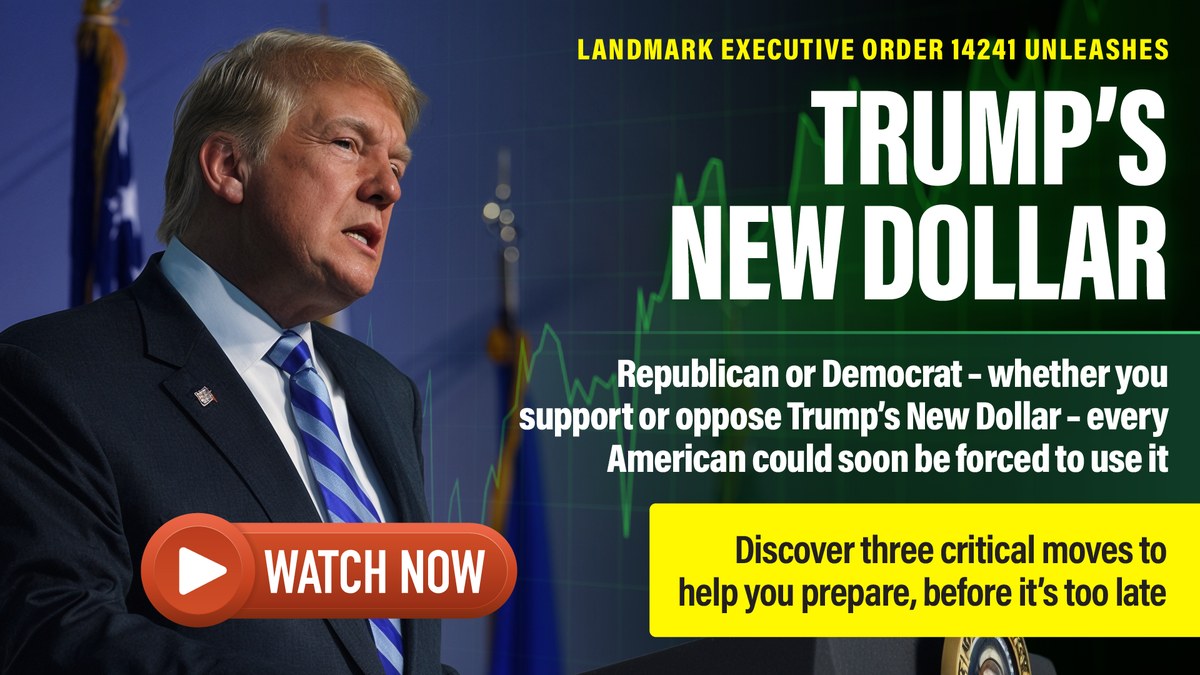
Before you go: in the message below, Porter Stansberry of Porter & Co. argues Musk plays a part in a coming shake-up of the dollar.
|
Why does the richest man in the world keep turning up at President Trump’s side?
Back in May, Elon Musk flew to Beijing on Air Force One alongside the President, one of only two CEOs, out of the 17 on the trip, given a seat on the President’s plane.
A year earlier, he was at Trump’s side in Riyadh, where the President personally introduced him to Saudi Crown Prince Mohammed bin Salman.
And he was in the room again in September, seated at the head table with Trump and Xi Jinping when the Chinese leader arrived for a state dinner at the White House.
Yet while the media obsesses over his rockets and robots, almost nobody is asking why he keeps showing up at these major political events.
My name is Porter Stansberry.
For nearly 30 years, I’ve helped millions of Americans move ahead of the market’s biggest shifts.
In 2006, I warned that Fannie Mae and Freddie Mac were heading for collapse, years before they brought the American banking system to its knees. Barron’s called my work “remarkably prescient.”
In 2008, I told readers General Motors was in a “death spiral,” less than a year before it filed for bankruptcy.
And in 2020, I warned that COVID-era money-printing would unleash the worst inflation in a generation. It did.
Today I would like to share fresh research that could have a bigger effect on your personal wealth than anything I’ve exposed before.
Without a vote in Congress, and with almost no coverage in the financial press, President Trump has set in motion what I believe is the first reset of America’s money since 1974.
Assembled through a flurry of executive orders and a landmark pact signed by 13 nations inside the State Department. And as you’ll see, I believe Elon Musk sits right at the center of it.
The last time America reset its money on this scale, by some estimates it minted more than a thousand new millionaires a day, while quietly hollowing out the savings of millions who never understood what was happening.
And on December 14, when world leaders gather at Trump’s Miami resort, I believe this new monetary order could be presented as a done deal.
In my documentary, you’ll discover:
| How Trump’s monetary reset connects everything from his tariff wars to his obsession with Greenland, and why I believe it’s all part of a larger plan to replace the petrodollar. | | Why the U.S. government is buying ownership stakes in tiny American mining companies, a move not seen since the depths of World War II. | | How the most popular investments of the last decade could be among the worst bets of the new monetary order. | | The five companies I believe sit at the heart of what’s unfolding, including the name and ticker of my No. 1 move before December 14. |
|
Good investing,
Porter Stansberry
|
|
|
One big story a weekday, followed to its end. If this is not for you, the button below takes you off the list.
|
|
The Last Page.
The last page, first. Reply and name the story you want finished.
|
|
Priority Gold endeavors to provide the most accurate useful information and helpful advice to the audience at its best. But there is no 100% guarantees of completeness, accuracy, usefulness or timeliness in or about the content. Any advice offered by Priority Gold are just our opinions and not to be relied on by anyone or any purpose. Seek your own legal, financial, tax, investment, and advice before opening an account with Priority Gold. All decisions regarding the purchase or sale of precious metals are solely at your decision only. This is an advertisement.
|
|
|