|
|
The Last Page.
The last page, first.
|
|
Is Your 2027 Social Security Raise Already Spent?
War-priced gasoline has forecasters calling for the biggest raise in years, and Wednesday morning sets it. A seniors’ group says the check will still buy less than it did in 2016.
|
|
A cost-of-living raise is built to keep you even. Getting ahead is a different story, and today’s partner tells one.
|
A MESSAGE FROM GREEN COFFEE COMPANY
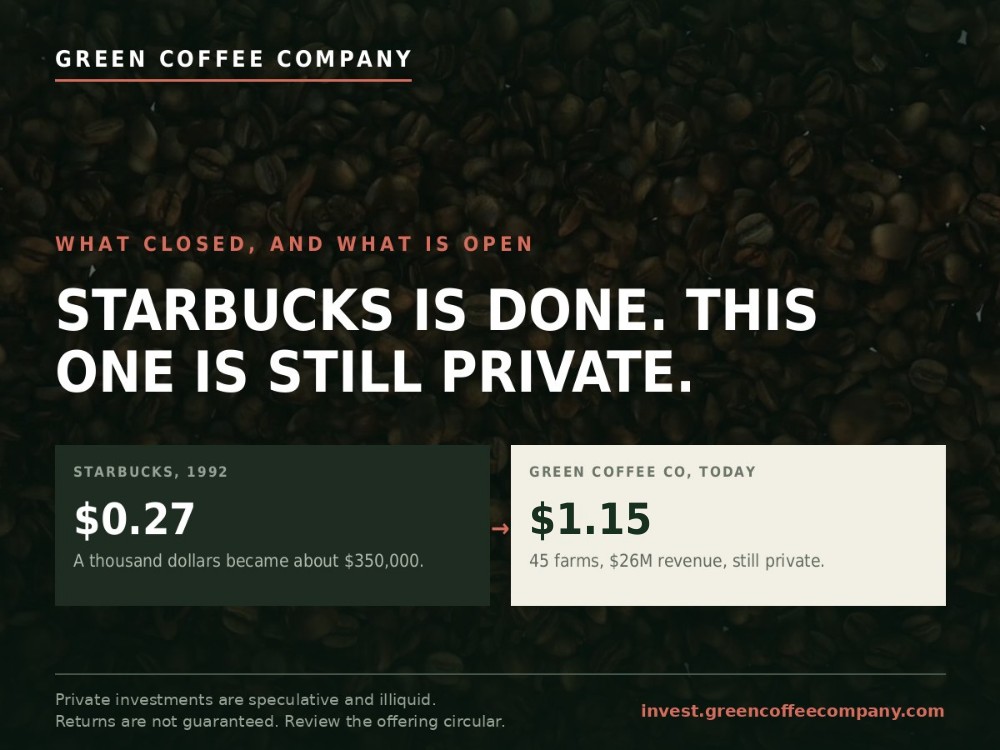
A thousand dollars of Starbucks in 1992 is about $350,000 today. That entry closed 34 years ago.
Past performance does not guarantee future results.
Private investments are speculative and illiquid. Returns are not guaranteed. Review the offering circular before investing.
|
|
|
The story
On Wednesday at 8:30 a.m. Eastern, the Labor Department posts September’s inflation report. Social Security uses it the same morning to set your raise for 2027.
The formula is plain arithmetic. It averages a price index called the CPI-W over July, August and September. Then it compares that with the same months a year earlier. July and August are already in, at 3.4% and 3.5% above a year before.
Gasoline did most of the lifting. In August it cost 27.4% more than a year before, the price of the Iran war and a choked Strait of Hormuz.
This one lands in your bank account in January. The average retired worker draws $2,087.52 a month. The Senior Citizens League forecasts 3.5%, which adds $73.06. For your own check, multiply it by 0.035.
Then the two camps split. AARP and Kiplinger’s David Payne expect 3.6%, the biggest raise since 2023, and the headlines are selling a bigger check. The Senior Citizens League asks what the check will buy. Its own study finds a benefit now buys 86.3 cents of what it bought in 2016.
|
|
+$73.06
The monthly raise for the average retired worker if the 3.5% forecast holds
|
|
−$6.60
The projected rise in the Medicare Part B premium, taken out of the same check
|
|
$66.46
What is left of the raise each month after Medicare, about $2.20 a day
|
|
|
CPI-W
|
The price index the raise is built on. It tracks what working households in cities spend, so it leans on gasoline and commuting more than on doctors’ bills.
|
|
|
Best case
APRIL 2027. The raise came in at 3.6%, and the bigger deposits started in January. Over the winter, tankers moved through Hormuz again.
Gasoline slid back toward $3.40, about where it stood a year before the war pushed it up. The formula worked in your favor this time. The raise was measured at the summer’s peak, and you collect it all year at spring prices.
At 3.6%, the average benefit reads about $2,163 before Medicare. Part B took its $6.60 more. What was left of the raise still covered a fill-up, with change.
Prices outside gas and food stayed calm, so the Federal Reserve left interest rates alone after its September hike. For once the yearly raise ran ahead of the bills, and it stayed ahead until the next one.
|
|
Worst case
|
JUNE 2027. The 3.5% raise arrived in January, and by spring it was used up. September’s report had shown prices climbing in the aisles as well as at the pump.
Six months of expensive diesel had worked its way into everything a truck delivers. The grocery bill caught the raise first. Then the insurance renewal and the plumber’s estimate passed it.
Medicare took its share before the money reached you. The Part B premium went to $209.50, and the drug-plan deductible climbed to $700.
The Federal Reserve, which had raised interest rates in September, raised them again. That might cool prices by next fall, long after this check was spent.
Social Security adjusts once a year, and prices adjusted every week. A benefit dollar now bought even less than 86.3 cents. The check that read like a raise in October felt like a pay cut by June.
|
|
|
Both scenes above turn on which way prices break. One former hedge fund manager says his Bitcoin method pays in either direction.
No coins, no wallets, no crypto exchanges. Just a regular brokerage account.
|
|
How it ends
You get a raise that outruns your bills for once, unless Wednesday shows inflation spreading beyond the gas pump.
We ran it both ways, and the size of the raise is the settled part. Two months are in. The Senior Citizens League called last year’s raise at 2.7% and the real one was 2.8%. Call this one 3.5% or 3.6%.
Your year turns on where the inflation lives. A raise sized by gasoline is a good deal if gasoline falls. It turns into a bad one if the rise has spread to rent, food and repairs. Those prices rarely come back down.
So far it lives at the pump. Core inflation leaves out food and energy. In August it was 2.4% higher than a year before, its lowest reading since March 2021.
The last time the formula fell behind was 2022. Retirees got 5.9% that January. By June, prices were up 9.1% on the year, and the catch-up raise waited for the next January.
If you already collect, budget about $66 more a month after Medicare. If you have not filed yet, the raise still counts. Every raise from age 62 on is built into the benefit you will start with. Under 62, none of this touches your check yet.
|
|
|
Core prices for September, posted Wednesday at 8:30 a.m. Eastern on bls.gov. This is the change from August, with food and energy left out, and forecasters expect 0.2%. A reading of 0.4% or more means inflation has spread beyond gasoline. Then the June scene above starts coming true.
|
|
|
One more thread
|
|
Each weekday we take one story and run it to the end. If you would rather stop getting these, the button below takes you off the list.
|
|
The Last Page.
The last page, first. Reply and name the story you want finished.
|
|
|